
About the way of Santiago
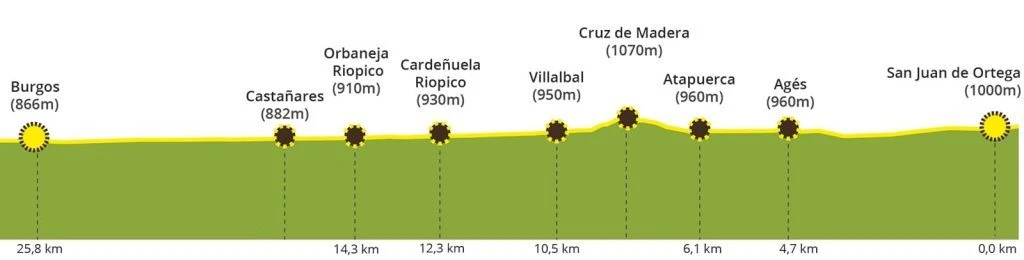
STAGE 11 Atapuerca – Burgos
THE WAY OF SANTIAGO TODAY
Today, the reasons pilgrims travel to Santiago along its various routes are incredibly diverse. Some walk for reasons of faith, as was the case in the early days of the Camino de Santiago. Many others prefer to enjoy the beautiful landscapes or meet adventurous people. Many walk to discover themselves, others to savor the food or wine, to be alone or in company… Many people embark on the Camino after a significant challenge in their lives or to prepare for such a challenge… And surely some or all of these motivations may coincide. Furthermore, there are likely as many reasons and paths as there are pilgrims, and discovering them is perhaps one of the most beautiful aspects of the journey. But in any case, it’s always wonderful to remember that the Camino doesn’t always give you what you want, but it always gives you what you need.
STORIES FROM THE WAY TO SANTIAGO
We offer you a brief glimpse into his origins and the history of the apostle. Because every good story has at least one main character, and ours features James the Greater, one of the disciples closest to Jesus of Nazareth.
If we combine impulses from different places and times, we could begin our story with this suggestive quote:
In a place in Roman Palestine, the name of which I do not wish to recall, there lived not long ago a fisherman of energetic and passionate character….
It was precisely on one of those days of fishing with his brother, also the apostle John, that he met Jesus.
A great friendship resulted from this, and consequently, a radical shift in his peaceful life by the Sea of Galilee. He went from being a fisherman of fish to a fisherman of men. James, the pilgrim, who traveled throughout Hispania.
We could say that he landed on the Iberian Peninsula twice, the first time full of life and passion to evangelize pagan souls, and the second time already deceased.
We don’t have many accounts of his first journey, although there are theories about his landing in Cartagena, his visits to the Ebro Valley, and the evangelization of the lands in the northwest of the peninsula. James made many good friends among the Hispanics, and from this emerged the seven Apostolic Men, who continued his work after the disciple’s return to his homeland.
To fulfill the promise to visit his teacher’s mother, Maria, on her deathbed.
He wasn’t the only one who returned, but he was the one who paid dearly for his audacity. He was soon captured by the Romans and his head severed from his body.
The threat fulfilled its fatal outcome and the legend of the first Path began.
Santiago had two faithful disciples in those tumultuous years: Theodore and Athanasius.
They were the ones who recovered his remains, and, inspired by their master’s wanderlust, they set sail in search of the last ray of sunlight in the west. According to medieval tradition, they crossed the Mediterranean, sailed along the Portuguese coast, and landed in what is now the Ría de Arosa in Galicia. Not content with that, they continued sailing, taking the high tide up the Ulla River to the Roman settlement of Iria Flavia, very near Padrón.
Other versions of the origins of the Camino de Santiago
There are also other versions about the origins of this ancient pilgrimage. In fact, there is talk of an even older version. It is said that the different routes along the Galaxia route to Fisterra have been attracting pilgrims since before the 8th century. The reason for this is that it was believed that the world ended in the city of Fisterra, or “the end of the earth,” and many wanted to see it for themselves.
* Required information
Data Controller: Hostel Atapuerca | Purpose: To respond to your inquiry | Legal basis: Your consent | Rights: You can limit, access, and delete your information at any time.